Estimated read time: 3 minutes
By Zach Wright, Cofounder at Syft AI
Every sales team is obsessed with email deliverability right now. DMARC, domain reputation, and warm-up sequences are the table stakes. But the conversation is stuck on the technical basics while missing the fundamental shift in how inboxes actually work.
Most teams are asking: "How do I get my emails past the spam filter?"
The better question is: "What are these filters actually learning to measure, and where is this headed?"
Where it is headed will break the outbound playbook most teams are running today.
The Experiment: Authorship vs. Substance
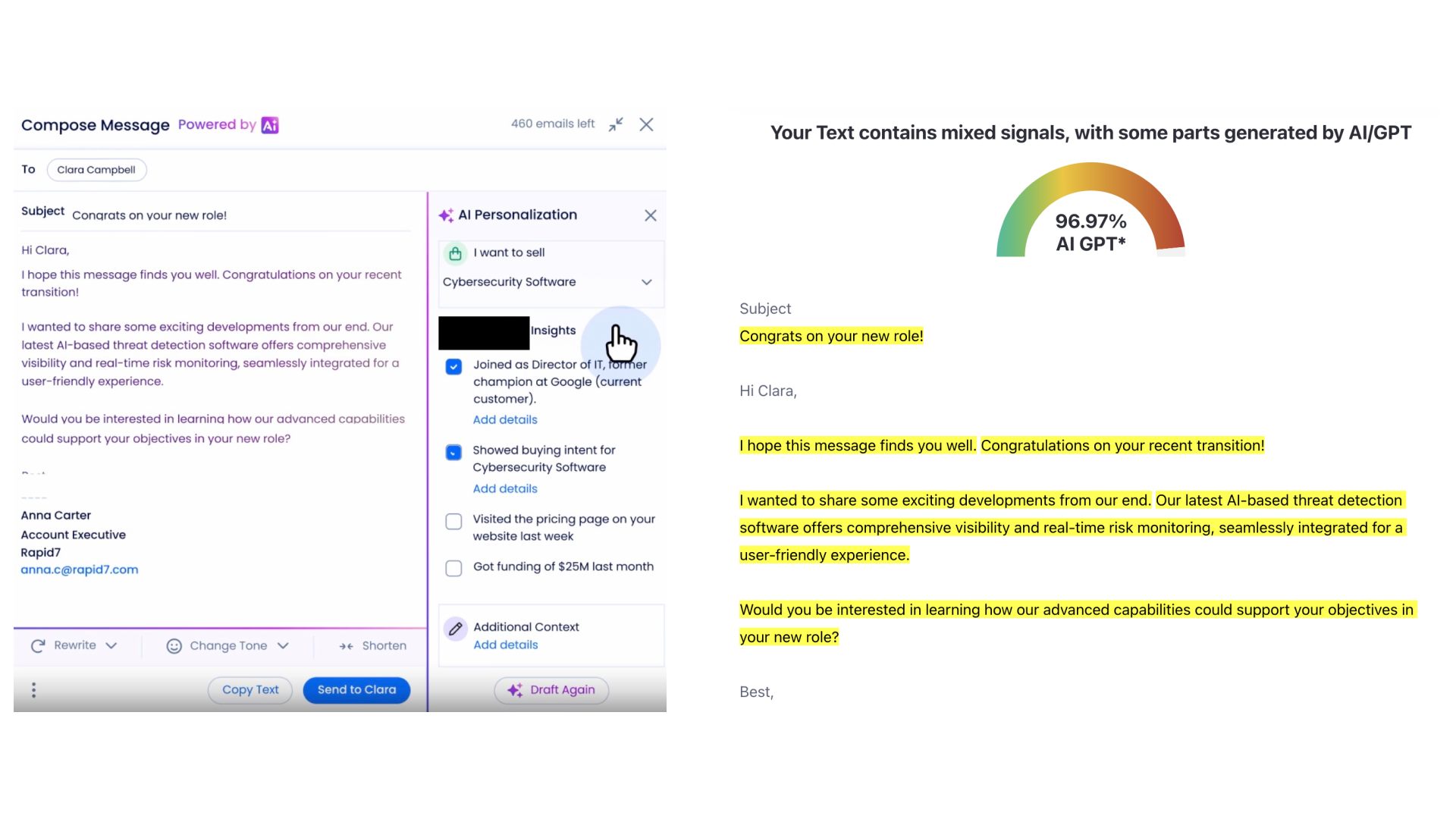
I recently took a sample email from the "AI email generator" of one of the largest sales platforms in the world. This was their featured example. Their best foot forward.
I ran it through two AI detectors. It scored nearly 100% AI-generated.
Then I ran an email powered by Syft through the same detectors. It scored 0% AI. 100% human-written.
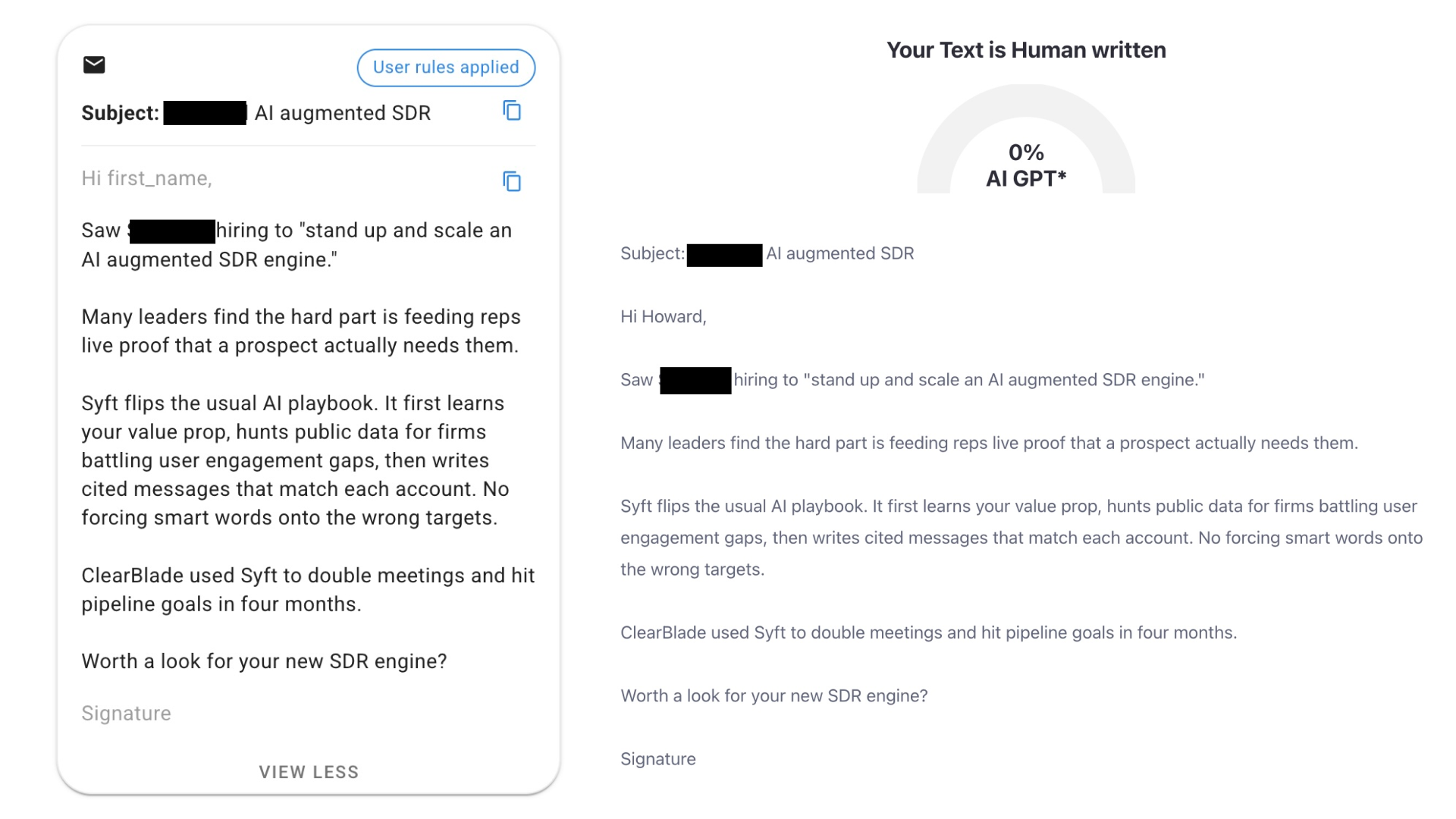
That email booked a meeting with a VP of Sales at the target company.
Here is the thing: both emails were written by AI. The detector scores are not measuring authorship. They are measuring depth.
The first email opens with a generic compliment, pivots to a standard pitch, and asks for time. You could swap the company name and nothing would change. The "personalization" is a first name and a job title. It is surface-level decoration on a template aimed at everyone, which means it is really aimed at no one. That is the pattern AI detectors are trained to catch.
The second email is also AI-generated, but it is the product of deep account research. It identifies something specific about what that company is actively building and connects it to a real challenge they are facing. It contains the kind of "tribal knowledge" that only a high-performer would typically know. The detector scored it as human because it reads like someone who actually did the work.
AI detectors are not scoring who wrote the email. They are scoring whether the email contains real, specific, verifiable observations about the recipient's world. When it does, it passes as human. When it does not, it gets flagged, even if a person typed every word.
The detector scores are not the point. They are a symptom of a deeper difference. And that difference is about to reshape how every inbox works.
The Rise of the AI Gatekeeper
This experiment is a preview of the near future. AI spam filters today are relatively simple. They check your reputation and look for patterns.
But these filters are evolving from simple walls into sophisticated gatekeepers.
The next generation of inbox protection will understand the priorities of the person they are protecting. These AI gatekeepers will know what the company is hiring for, what initiatives they are investing in, and what problems they are actively trying to solve.
The gatekeeper will ask one question: "Does this message align with what this person cares about right now?"
If your email is just a "personalized" template that has nothing to do with their actual world, it will never reach the inbox. It will be filtered out not because it was written by AI, but because it is irrelevant.
The Choice: Volume or Relevance
For a long time, outbound sales has been a numbers game. Send enough emails and you will eventually stumble into someone with a problem.
That era is over. Scaling volume without precision is now a liability. It ruins your domain reputation and, more importantly, it will soon be mathematically impossible to reach your prospects through the noise.
The question for any sales leader is straightforward. Is your team scaling volume or scaling relevance?
At Syft, we built the research layer that sits in front of outreach. We find the companies that have an active, validated reason to talk to you right now. We call them "Value Matches."
AI is about to make the choice for you. You can either use AI to send a thousand generic messages, or you can use it to find the one reason that actually earns you a seat at the table.